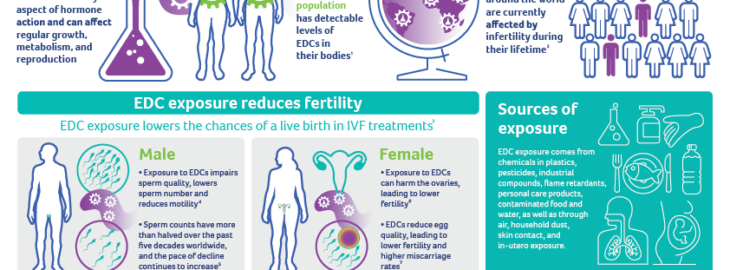
With the aim of enhancing awareness on the critical role that hormones play in maintaining good health, World Hormone Day is now celebrated on 24 April all around the world after having evolved from European Hormone Day. The primary focus of this initiative is to raise awareness about the importance of maintaining good hormone health. Hormone health is determined by a variety of factors, such as nutrition and genetics, but one factor that is increasingly leading to concern is the exposure to Endocrine Disrupting Chemicals (EDCs).
EDCs are chemicals that disrupt or influence hormone levels in our bodies. Given that hormones are responsible for several essential bodily functions like growth, metabolism, reproduction, and development among others, even slight disruptions can have significant impacts on human health. The vast majority of the world’s population has traces of such chemicals in their bodies. This may be through several means like plastics, pesticides, industrial chemicals, fire retardants, personal care products, water or food contamination, household dust, air pollution, skin contact, and exposure of the mother during pregnancy. Endocrine Disrupting Chemicals are prevalent enough in today’s environment that one cannot avoid them.
Reproductive organs seem to be especially vulnerable to hormonal changes. Prof. Pauliina Damdimopoulou, a member of the EDC working group of ESE points out: “Exposures to chemicals that can interfere with the body’s own hormones is common, and research over the past 2 years has consolidated many of the original hypotheses from the 90s: human fertility is affected by chemical pollution.” EDCs affect male fertility by lowering the quality of sperm cells, lowering their concentration in semen, and hampering their ability to move through female reproductive organs. There is evidence that global sperm counts have dropped below 50% of previous values during the last five decades and there is an indication that this trend is continuing (1). On this topic, Prof. Willem Ombelet, ESHRE’s key expert on fertility and the environment, observes that: “There is growing concern that exposure to endocrine-disrupting chemicals may contribute to reduced fertility in humans, including declines in sperm quality and increased incidence of reproductive disorders.” When it comes to female fertility, exposure to EDC may lead to the deterioration of functions related to ovaries, poorer quality of oocytes, and higher rates of miscarriages. It was also found that certain types of EDC exposure negatively affect the chances of a live birth when utilizing assisted reproductive technology (ART) (2).
It is being increasingly recognized that greater action is required to limit exposure and protect the health of people. Though individuals can take action to limit their own exposure by reducing the use of plastics, avoiding dangerous chemicals in beauty and household products, and choosing food wisely, many believe that accountability cannot fall on individuals alone. The widespread presence of EDCs in consumer products and the environment requires policy interventions. Legal restrictions, testing, and controls on dangerous chemicals appear necessary to limit exposure at a population level. In the words of Anita Fincham from Fertility Europe, “The scale of EDC exposure demands a response at the source. It is the responsibility of EU policymakers to restrict harmful chemicals at the point of production and supply – not to place an impossible burden of vigilance on citizens and patients who are already paying the price with their health and their fertility. Fertility Europe is grateful to join forces with ESHRE and the ESE in making this case with one unified voice.”
While World Hormone Day is an awareness campaign that is tied to one particular day, its aim is to promote further discussion throughout the whole year and to contribute to policy change for better hormone health. With more information becoming available about EDCs, there is a common recognition among researchers and patient advocacy groups that there needs to be more awareness raised about harmful substances. The new infographic on EDCs and fertility aims to contribute to this cause. ESHRE members are invited to check it out and to share it as widely as possible.
- Levine, H., Jørgensen, N., Martino-Andrade, A., Mendiola, J., Weksler-Derri, D., Jolles, M., Pinotti, R., & Swan, S. H. (2023). Temporal trends in sperm count: A systematic review and meta-regression analysis of samples collected globally in the 20th and 21st centuries. Human Reproduction Update, 29(2), 157–176. https://doi.org/10.1093/humupd/dmac035
- Yuan, M., Chai, J., Song, J.-Y., et al. (2025). Association of bisphenol A exposure with in vitro fertilization outcomes: A meta-analysis and systematic review. Reproductive Toxicology, 138, Article 109071. https://doi.org/10.1016/j.reprotox.2025.109071

You have to be logged in and an ESHRE member in order to comment.