
AI has the potential to transform the IVF clinic and embryology lab but must be rigorously validated to separate hype from reality.
This was the key message from a session on the incorporation of AI in clinical practice which featured evidence that algorithms are helping to predict treatment outcomes, balance clinic workloads, and reduce drop-out rates.
Ariel Hourvitz, from Tel Aviv University, said AI is already being applied at all stages of fertility treatment and IVF including selecting the day of the trigger shot. Triggering was described by Professor Hourvitz as one of the most subjective and debated aspects of IVF. This is where AI can play an important role: it can help reduce subjectivity and support more consistent, data-driven decisions by analysing large datasets and identifying subtle patterns.
What clinicians really want to know is when to administer the trigger to obtain the highest number of oocytes. In his talk, Professor Hourvitz described how he and his team developed a machine-learning algorithm to predict how many oocytes will be aspirated on each candidate day in order to choose the best timing. Backed up by real-life data from patient case studies, the study findings showed that clinics retrieve more oocytes when the trigger is performed on the day recommended by AI. Of note, is the fact the algorithm takes into account all patient details such as BMI and age.
An algorithm for ovulation prediction, also devised by Professor Hourvitz, has been shown to achieve 93% accuracy (2). The same AI-based tool was used to predict ovulation six days in advance with the aim of avoiding weekend transfers.
It successfully minimised the number of transfers performed on non-working days, while keeping the majority of cycles completely natural. In 40% of cycles, the algorithm estimated ovulation on a day that would have meant a Saturday or Sunday transfer, thus trigger was suggested.
Oocyte pick-ups (OPUs) are another significant issue for labs. A study presented by Professor Hourvitz featured an algorithm designed to improve workflow by moving the aspiration of eggs from difficult to easy days. By balancing OPU timings, an average increase of 21% was achieved in the daily number of retrievals performed by the clinic without the need for additional resources.
His team is now using the data they have collected to perform RCTs with a view towards full AI integration in a safe and responsible way. In the question-and-answer session, Professor Hourvitz was asked whether pregnancy and live birth should be the primary standard for AI, not number of eggs retrieved. In response, Professor Hourvitz acknowledged that it was always a dilemma to choose the benchmark for training an algorithm. However, he asserted that metaphase II oocytes were the best goal and ‘more eggs usually mean more babies’.
Proclaiming ‘the future is here’, Professor Hourvitz said AI will replace many current functions performed in clinics, probably change how medicine is practised but not replace ‘us’ (clinicians). Physicians will still need to add their own experience when using AI – this may even result in the algorithm being over-ruled.
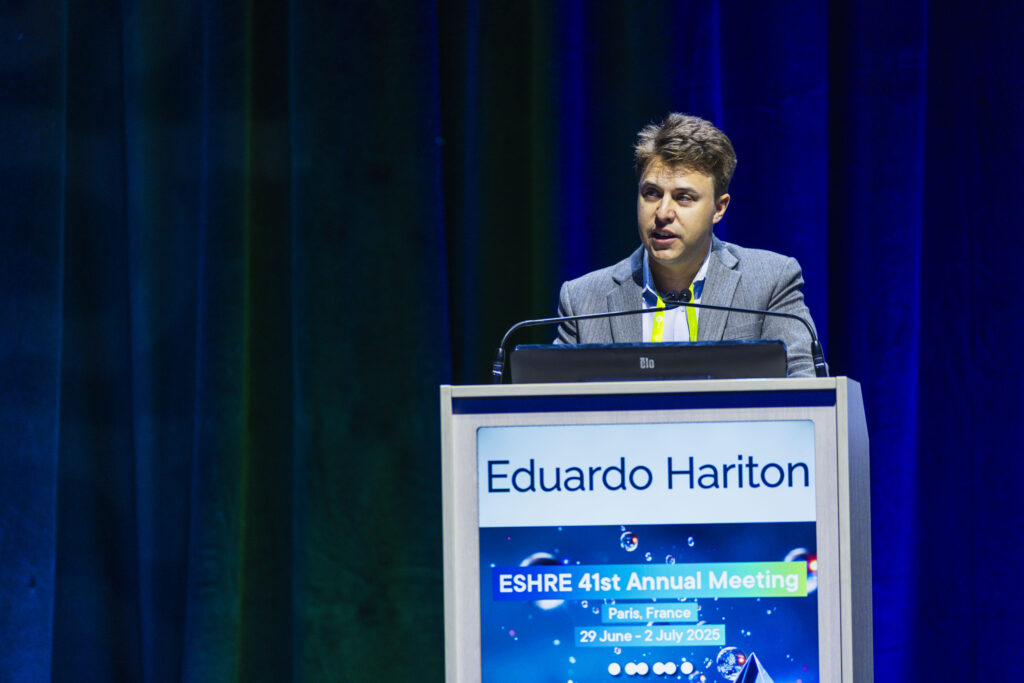
The second speaker Eduardo Hariton presented data on how AI can be leveraged to enhance ovarian stimulation. This is from a perspective of outcome prediction, gonadotropin dose selection, follicular monitoring, trigger optimisation, and level loading where AI can balance throughput rates of activities within the operating room.
AI is needed, he said, because in the changing landscape of fertility treatment, clinics are looking to adopt technology that can help in delivering better outcomes, more efficiently. This includes accurate prognosis before or during a treatment cycle which can be vital for patient counseling and treatment planning.
To illustrate his point, Dr Hariton outlined details of an AI-driven tool developed by the physician-led fertility network USFertility. Using millions of data points from real patients, the algorithm provides those seeking fertility treatment with a personalised probability of success for IVF, IUI and egg freezing.
AI is also being used to automate follicular monitoring. Deep learning models can use 3D sweeps to measure follicles quickly and accurately, according to Dr Hariton. This can be achieved via remote ultrasound reviews that spare patients the time of cost of travelling to a clinic. Faster monitoring by less trained staff, standardised accuracy, surgical planning are among the advantages outlined by Dr Hariton who practices at the Reproductive Science Center of the San Francisco Bay Area, USA.
An increase in papers being submitted on AI creates a need for more peer-reviewers, said Dr Hariton who made an appeal for an expansion of the peer-review process. He praised small start-up companies who are prepared to endure the ‘pain’ of waiting for data on their AI-based technologies to be properly evaluated.
References
1 An artificial intelligence-based approach for selecting the optimal day for triggering in antagonist protocol cycles
Reuvenny, Shachar et al. Reproductive BioMedicine Online, Vol 48 (1); 103423
2 Luz A, Hourvitz A, Moran E et al. Improved clinical pregnancy rates in natural frozen-thawed embryo transfer cycles with machine learning ovulation prediction: insights from a retrospective cohort study. Sci Rep 14, 29451 (2024). https://doi.org/10.1038/s41598-024-80356-8

You have to be logged in and an ESHRE member in order to comment.