
Presented today at the 42nd Annual Meeting of the European Society of Human Reproduction and Embryology (ESHRE), the study found that lifestyle habits were broadly similar across regions and did not explain the differences observed, raising important questions about the role of environmental exposures in male reproductive health.
The prospective multicentre study analysed semen quality and lifestyle data from 386 men undergoing fertility assessment across seven assisted reproduction centres in Spain between June 2024 and December 2025.
Participants completed a standardised questionnaire covering factors including residence, body mass index (BMI), medical history, physical activity, chemical exposure, medication use, smoking, alcohol, drug and coffee consumption.
Researchers then compared semen parameters across four regions of Spain – north, south, southeast and central – to determine whether geographical differences in sperm quality could be explained by lifestyle or socio-demographic factors.
The results revealed significant regional differences in semen volume, sperm concentration, motility, morphology and total motile sperm count, as well as the prevalence of asthenozoospermia (reduced sperm motility) and teratozoospermia (abnormal sperm morphology).
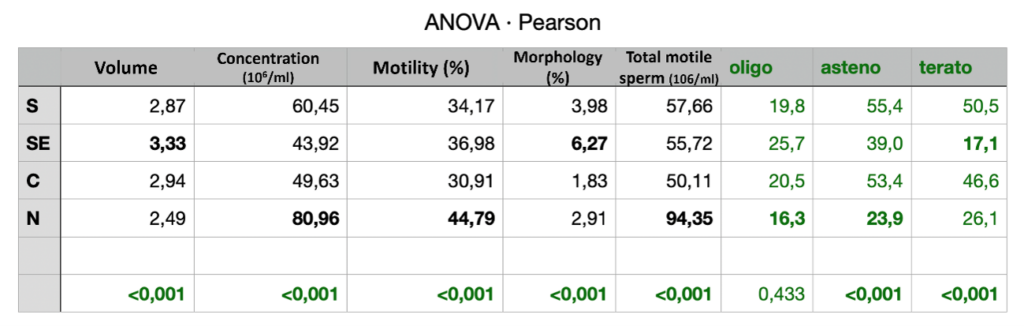
Men living in northern Spain recorded the strongest semen quality overall, with an average total motile sperm count of 94.35 million, compared with 50.11 million in central Spain (see Figure 1).
The northern region also had the highest average sperm concentration (80.96 million/ml) and sperm motility (44.79%). Reduced sperm motility affected 23.9% of men in the north, compared with 55.4% in southern Spain and 53.4% in central Spain.
Despite these differences in semen quality, lifestyle habits and overall lifestyle patterns were broadly similar across the four regions studied. After adjustment for all measured lifestyle and socio-demographic factors, only geographical location and abstinence duration remained independently associated with semen parameters.
Total motile sperm count was independently associated with both geographical location and abstinence duration, while geographical location alone remained significantly associated with the prevalence of reduced sperm motility and abnormal sperm morphology.
Lead author Professor Rocío Núñez-Calonge said: “What was most remarkable for us was that the strongest semen quality parameters were consistently found in northern Spain. At the same time, we were surprised to find that lifestyle habits were very similar across all the geographical areas studied.”
“If, based on the results of this study, we rule out male lifestyle habits as the explanation for the geographical differences observed in semen quality, it seems likely that these variations may instead be related to differences in environmental exposure, such as levels of pollution or other environmental contaminants present in those areas,” Professor Núñez-Calonge explained.
Professor Núñez-Calonge noted that the findings may have implications beyond Spain, with studies from several countries reporting significant regional variations in semen quality, particularly in areas with marked environmental heterogeneity.[2-8]
Looking ahead, Professor Núñez-Calonge said: “Given the widespread presence of air pollution in many urban environments, its potential effects on male fertility deserve further investigation.”
“Larger and well-designed studies are needed to better clarify the relationship between environmental exposure and semen quality. At the same time, stronger public health policies aimed at reducing exposure to pollutants, industrial chemicals and plastic-derived compounds should be considered as a priority for protecting reproductive health in future generations,” Professor Núñez-Calonge concluded.
[INSERT EXECUTIVE COMMITTEE QUOTE HERE]
The study abstract will be published today in Human Reproduction, one of the world’s leading reproductive medicine journals.
ENDS
Notes to editors:
A reference to the ESHRE Annual Meeting must be included in all coverage and/or articles associated with this study.
For more information or to arrange an expert interview, please contact the ESHRE Press Office at: press@eshre.eu
Figure 1:
About the author:
Professor Rocío Núñez-Calonge holds a PhD in biology and is a specialist in human reproduction, with postdoctoral training at the University of Pennsylvania. She is also a senior embryologist certified by ESHRE and a holder of a master’s degree in bioethics. She has extensive experience in research, teaching and scientific leadership, serving on the boards of professional societies, editorial committees and as a speaker at international conferences. Currently, she is a scientific advisor to the UR Group (International Reproduction Unit) and coordinator of the Ethics Group of the Spanish Fertility Society. Her research focuses on male infertility, low ovarian reserve and reproductive ethics.
About the European Society of Human Reproduction and Embryology:
The main aim of ESHRE is to promote interest in infertility care and to aim for a holistic understanding of reproductive biology and medicine.
ESHRE collaborates world-wide and advocates universal improvements in scientific research, encourages and evaluates new developments in the field, and fosters harmonisation in clinical practice. It also provides guidance to enhance effectiveness, safety and quality assurance in clinical and laboratory procedures, psychosocial care, and promotes ethical practice. ESHRE also fosters prevention of infertility and related educational programmes and promotes reproductive rights regardless of the individual’s background. ESHRE’s activities include teaching, training, professional accreditations, mentoring and career planning for junior professionals, as well as developing and maintaining data registries. It also facilitates and disseminates research in human reproduction and embryology to the general public, scientists, clinicians, allied personnel and patient associations.
Website: https://www.eshre.eu/
About Human Reproduction:
Human Reproduction is a monthly journal of ESHRE and is one of the top three journals in the world in the field of reproductive biology, obstetrics and gynaecology. It is published by Oxford Journals, a division of Oxford University Press.
References:
[1] Núñez-Calonge, R., et al. (2026). Does male lifestyle influence geographical differences in sperm parameters? Human Reproduction.
[2] Auger, J., Eustache, F., Chevrier, C., & Jégou, B. (2022). Spatiotemporal trends in human semen quality. Nature Reviews Urology, 19(10), 597–626. https://doi.org/10.1038/s41585-022-00626-w
[3] Rahban, R., & Nef, S. (2020). Regional difference in semen quality of young men: A review on the implication of environmental and lifestyle factors during fetal life and adulthood. Basic and Clinical Andrology, 30, 16. https://doi.org/10.1186/s12610-020-00114-4
[4] Jørgensen, N., Andersen, A.G., Eustache, F., Irvine, D.S., Suominen, J., Petersen, J.H., Andersen, A.N., Auger, J., Cawood, E.H., Horte, A., Jensen, T.K., Jouannet, P., Keiding, N., Vierula, M., Toppari, J., & Skakkebaek, N.E. (2001). Regional differences in semen quality in Europe. Human Reproduction, 16(5), 1012–1019. https://doi.org/10.1093/humrep/16.5.1012
[5] López-Teijón, M., Elbaile, M., & Alvarez, J.G. (2008). Geographical differences in semen quality in a population of young healthy volunteers from the different regions of Spain. Andrologia, 40(5), 318–328. https://doi.org/10.1111/j.1439-0272.2008.00862.x
[6] Núñez, R., Guijarro, A., Alberola, P., Santamaría, N., Poveda, M., Mora, A., Masip, M., Sánchez, S., Alonso, S., Rubio, T., Barros, I., González, P., Gili, S., & Álvarez, I.S. (2024). Study of Seminal Quality Variations in Men Across 12 Geographical Locations in Spain. Archives of Medical Research. 55(8):103140. doi: 10.1016/j.arcmed.2024.103140
[7] Rahban, R., Santa-Ramírez, H.-A., Senn, A., Stettler, E., Guessous, I., Joost, S., & Nef, S. (2025). Exploring geographical differences in semen quality of young men using spatial dependence analysis. Human Reproduction, 40(12), 2409–2418. https://doi.org/10.1093/humrep/deaf182
[8] Liu, J., Dai, Y., Li, Y., Yuan, E., Wang, Q., Wang, X., & Guan, Y. (2020). A longitudinal study of semen quality among Chinese sperm donor candidates during the past 11 years. Scientific Reports, 10(1), 10771. https://doi.org/10.1038/s41598-020-67707-x
