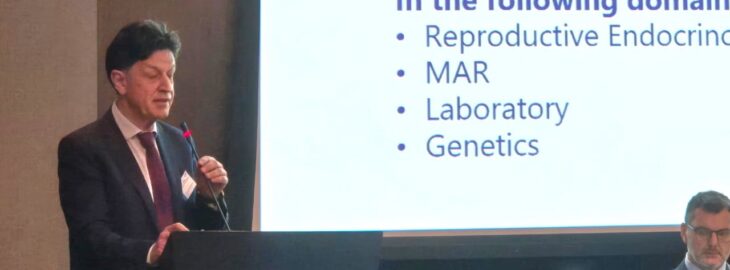
Reproductive medicine has undergone rapid and profound development over recent decades, driven by advances in reproductive endocrinology, embryology, genetics, and medically assisted reproduction (MAR). These developments have highlighted the need for harmonised, high-quality subspecialty training across Europe. In response, the first European Training Requirements (ETR) for Reproductive Medicine were developed in collaboration with ESHRE and the European Board and College of Obstetrics and Gynaecology (EBCOG). The ETR aims to standardise training, ensure patient safety, and promote excellence in clinical practice, research, and ethical care.
Development and UEMS approval of the ETR
The creation of the first ETR for reproductive medicine was undertaken by a dedicated working group composed of experts in the field. Under the leadership of Professor Antonios Makrigiannakis, the group first developed the core educational foundations of the programme, namely the syllabus and the logbook. These documents defined the scope of training, learning objectives, procedural exposure, and competency assessment required for subspecialist formation.
Building upon the syllabus and logbook, the first ETR for reproductive medicine was subsequently formulated as a comprehensive framework encompassing clinical, academic, and professional competencies. The completed ETR was formally submitted to the European Union of Medical Specialists (UEMS) for evaluation. Following submission, the ETR was presented by Professor Makrigiannakis to the UEMS council during the UEMS Autumn council meeting held on 17–18 October in Tbilisi. After review and discussion, this new set of standards received unanimous approval by the UEMS council, marking a milestone in the formal recognition and standardisation of subspecialty training in reproductive medicine at the European level.
Aims and objectives of training
The overarching aim of the ETR is to prepare obstetricians and gynaecologists to become highly competent, reflective, and ethically grounded subspecialists capable of delivering evidence-based, patient-centred care in human reproduction. The programme seeks to develop advanced clinical competence in infertility diagnosis and treatment, MAR, reproductive endocrinology, menopause care, and fertility preservation. Additional objectives include building expertise in reproductive genetics, immunology, and andrology, strengthening surgical skills, and fostering leadership, academic development, and service organisation.
Training objectives are structured around three domains: clinical competence, academic and research competence, and professional and organisational competence. Graduates are expected to practise independently and safely while contributing to innovation, education, and quality improvement within reproductive healthcare.
Trainee profile and competency framework
Entry into the programme requires certification in obstetrics and gynaecology, with foundational knowledge in:
- Anatomy
- Physiology
- diagnostic testing
- experience in common gynaecological disorders
- early pregnancy care
- demonstrated professionalism and communication skills
The competency framework is aligned with the Canadian Medical Education Directions for Use (CanMEDS) roles, encompassing medical expert, communicator, leader, health advocate, and scholar. This approach ensures the development of both technical expertise and essential non-technical skills, including teamwork, leadership, ethical reasoning, and patient advocacy.
Training content and learning outcomes
The curriculum consists of seven core modules covering fertility preservation, infertility diagnosis and treatment, reproductive health issues, assisted reproductive technologies, andrology and male reproductive health, reproductive endocrinology, ethical and legal aspects, psychological support and counselling, research methodology, and public health considerations.
Learning outcomes span theoretical knowledge, clinical and surgical skills, laboratory competence, and counselling abilities. Trainees must gain proficiency in ultrasound, oocyte retrieval, embryo transfer, reproductive surgery, cryopreservation, and preimplantation genetic testing (PGT), as well as the interpretation of laboratory and genetic results. Counselling competencies include psychological, ethical, and legal guidance for patients and couples.
Practical training and competence assessment
Practical training encompasses reproductive endocrinology, early pregnancy and implantation, fertility preservation in oncological and benign conditions, MAR laboratory exposure, and andrology. Minimum procedural requirements ensure sufficient clinical exposure, including diagnostic and operative hysteroscopy and laparoscopy, fertility case management, transvaginal ultrasound, and interpretation of sperm analysis.
Competence is assessed using a five-level scale ranging from passive attendance to independent practice and supervision. By the end of training, trainees must achieve level 4 competence (independent practice) in all key areas of reproductive medicine and level 5 competence (teaching and supervision) in core domains.
Entrustable professional activities
Entrustable professional activities (EPAs) operationalise competencies into real-world clinical responsibilities. EPAs include comprehensive infertility and reproductive endocrinology work-up, design and supervision of controlled ovarian stimulation, performance of ultrasound-guided oocyte retrieval and embryo transfer, management of the MAR laboratory interface, interpretation of PGT results, and management of recurrent implantation failure and recurrent pregnancy loss.
Additional EPAs address male infertility, early pregnancy complications, fertility preservation, obesity in MAR, multidisciplinary team leadership, and navigation of ethical, legal, and cultural frameworks.
Organisation, governance, and conclusion
The programme has a minimum duration of two years with structured milestones, formative and summative assessments, and a validated trainee logbook. Training is delivered in ESHRE-accredited centres aligned with ESHRE and EBCOG standards. Trainers must be certified subspecialists with substantial clinical, research, and teaching experience.
In conclusion, the first European Training Requirements for Reproductive Medicine establish a robust, harmonised framework for subspecialty training across Europe. Their unanimous approval by the UEMS confirms their scientific, educational, and professional validity and represents a significant step toward ensuring high-quality, ethical, and standardised reproductive healthcare throughout Europe.
The Working Group
1. Antonios Makrigiannakis (Working Group President) (Greece)
2. Tatjana Motrenko Simić (Montenegro)
3. Dinka Pavičić Baldani (Croatia)
4. Barış Ata (Turkey)
5. Roy G Farquharson (United Kingdom)
6. Abha Maheshwari (United Kingdom)
7. Kenny A Rodriguez (Sweden)

You have to be logged in and an ESHRE member in order to comment.