This is MHR’s unique scope within the family of ESHRE journals. I want to celebrate this momentous anniversary, which coincides with the beginning of the fourth decade (MHR goes fo(u)rth), by reviewing MHR’s journey, offering my own assessment of where MHR stands today in terms of achievements, challenges and priorities for the future.
The original reason to start MHR was that the study of reproduction was making a qualitative leap forward in terms of research tools in the wake of the human genome project. The initial emphasis of MHR was on human studies, although Edwards had always made it clear that relevant data from animal studies would also be welcome in MHR, provided they helped to better understand human reproduction. When Edwards left MHR, the terms that appeared more frequently in the titles of MHR papers published in 2000 were ‘human,’ ‘gene expression,’ ’endometrial cells,’ and ‘pregnancy’, but no animals.
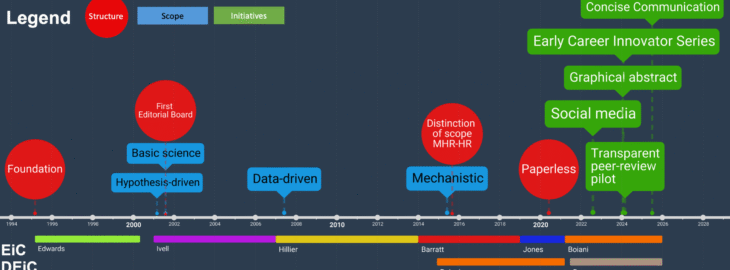
Meantime, almost 30 years and five Editors-in-Chief (EiCs) have passed: Richard Ivell (2000–2006), Stephen Hillier (2007–2012), Chris Barratt (2013–2018), Keith Jones (2019–2021) and me (2021 to date). After Edwards’ Herculean task of getting MHR off the ground, the subsequent EiCs had the equally difficult task of keeping the Journal in step with the evolving needs and challenges of the different times. The second EiC, Richard Ivell, equipped MHR with an Editorial Board of Associate Editors and defined a structured manuscript workflow that essentially still exists today. Ivell also gave MHR the spirit that still distinguishes it today, namely as a journal for publishing basic science conducted in humans and animal models. The terms that appeared more frequently in the titles of MHR papers published in 2006, the last year of Ivell’s term, were ‘human’ and ‘gene expression,’ as well as ‘endometrium,’ ‘pregnancy,’ and ‘preeclampsia’ – but still no animals.
The transition to Stephen Hillier as the third EiC in 2007 introduced another element to sharpen the identity and scope of MHR. Hillier had noted that next to hypothesis-driven studies, there were also more and more data-driven studies as a result of post-genomic reproductive (and regenerative) biomedicine being in transition and decided that the scope and focus of MHR should adjust accordingly. Therefore, Hillier opened MHR not only to hypothesis-driven but also data-driven studies, and placed ‘data-driven’ next to ‘basic science’. The terms that appeared more frequently in the titles of MHR papers published in 2012, the last year of Hillier’s term, were ‘human,’ ‘gene expression,’ ‘endometriosis,’ and ‘ovary’, with the new entries ‘analysis’ and ‘sperm’.
Until 2012, the EiCs of MHR, with Edwards and Hillier, represented the female side of reproductive science, and this was partly true for Ivell as well. With the arrival of Chris Barratt in 2013 MHR appointed a leading scholar in sperm biology as the fourth EiC, and sealed the belonging of andrology in MHR. Barratt’s approach to sharpening the profile of MHR was to emphasize the mechanistic nature of the studies and make the manuscript selection process more rigorous. In addition, Barratt also pledged to increase the attention of the peer review process to the reproducibility of the experimental methods, and make the distinction of scope between HR and MHR more clear. Analysis of the terms that appeared more frequently in the titles of MHR papers published in 2018, the last year of Barratt’s term, shows that ‘analysis’ and ‘sperm’ were still rising, next to the traditional hits ‘human,’ ‘gene expression,’ ‘endometriosis,’ and ’ovary’. Toward the end of Barratt’s tenure, ‘Plan S’ of the cOAlition S shook the landscape of academic publishing. This was a project supported by major national and international research funding bodies, with the goal to make readers not having to pay for reading (Open Access) and to end the age of publications on paper.
With the fifth EiC, Keith Jones, MHR progressed into the digital transition, becoming online-only, i.e. paperless, in 2020. There was also a transition to what I like to call ‘the mouse people in charge,’ that is, basic scientists conducting research in animal models, unlike the previous editors who were closer to the clinical field. This is also reflected in the analysis of the most frequent terms in the MHR article titles of 2021, where ‘mouse’ became prominent for the first time. Jones also pledged for more diversity in the geographical distribution of the Editorial Board, and reasoned that Authors would be encouraged to choose MHR if we could make their life easier, via a simpler way to submit their work to the journal (e.g. initial submission in any format). Analysis of the terms that appeared more frequently in the MHR titles reveals that there was no longer a clear dominance of ‘human’ and ‘gene expression,’ and that there were more major terms than before that defined the scope of the works published in MHR: for example, ‘cells,’ ‘mouse,’ ‘sperm,’ ‘development,’ ‘pathway,’ ‘endometrium,’ and ‘embryo.’ Of note, the two terms ‘human’ and ‘mouse’ were head-to-head.
When I became EiC in 2021, my first objective was to consolidate the achievements of my predecessors before going new ways. Therefore, I wanted first and foremost to keep publishing only the highest quality studies, preserve the gravitas of the Editorial Board, and maintain the clear distinction of scope between MHR and the other ESHRE journals. To make MHR fit for function, we recruited an outstanding Deputy Editor, Francesca Duncan. As was the case for my immediate predecessor, the core challenge also during my time was to attract authors in times when they have a wide choice of journals to choose from, as well as younger researchers who may not know about MHR’s reputation, scope or mission. Accordingly, MHR launched several new initiatives, such as: presence on social media (Twitter/X, LinkedIn, Bluesky), non-mandatory graphical abstracts (ideal for dissemination in the social media), transparent peer review, and new ways to showcase authors and their work – most notably the Early Career Innovator Series created by Francesca Duncan. At the time of writing, yet another article format has just been launched, the Concise Communication, which is similar to an original research paper except that it is around half the length. I think that length alone should not be a barrier in the case of submissions to MHR, provided the studies reach a definite and safe conclusion, and prioritize molecular understanding over merely reporting findings. All these things should increase the appeal of MHR for authors, and I think this is happening, judging by the growing variety of what we publish. The analysis of the terms that now recur more frequently in the MHR titles denotes an increase in the diversity of subtopics covered by MHR. The hits include ‘cells,’ ‘human’ and ‘mouse’ (again head-to-head), ‘development,’ ‘pathway,’ ‘endometrium,’ and ‘embryo’.
At this point, after the retrospective analysis, I wish to take stock of all the things I have said in order to imagine what the future of MHR might look like. One priority is to stay ahead of the curve in the competition with other journals for authors in our field. Apart from the appeal of initiatives such as the Early Career Innovator Series, Authors’ decision to submit their work to one or another journal is based on multiple factors, including editorial speed and post-publication visibility. MHR should want to be faster too, but not at any cost, because thorough examination of a manuscript requires time. This should be the difference advertised by MHR compared to other journals, and this is where communication channels such as social media play an increasingly important role. MHR was the first of the ESHRE journals to establish a presence on social media, and it seems to be working well. A second priority is the strategic development of the journal’s content in the long term. MHR has a scope that is distinct from that of the other ESHRE journals. MHR is ESHRE’s basic science journal, which makes it unique, but ESHRE is a clinical society, and this can be perceived as a discrepancy. We must do a better job of communicating that basic research is not in contradiction with clinical research, but rather forms the basis for it. MHR calls itself multidisciplinary because its studies encompass a variety of methods from multiple disciplines, but in terms of topic, it is mono-disciplinary. Reproduction as a topic, although essential, is not of general interest (many people do not want to have children, who distract them from their careers), and it is difficult for a mono-disciplinary journal based on basic research articles to increase its impact factor. Provocatively, one could even say that a threat to MHR is its own scope, which is not broad, let alone multidisciplinary. However, I feel that broadening the scope could jeopardize the uniqueness of MHR and so our priority should remain to prioritize depth (quality) over breadth (number of papers published). MHR should look with interest at opportunities such as the publication of evidence-based guidelines or position papers on emerging topics that could shape the future of reproduction, such as the organoids and the stem cell-based embryo models.
In conclusion, during its first 30 years, MHR has developed a secure footing in reproductive science. The journal’s consistent Q1 status indicates sustained scientific influence. However, the future is more difficult to predict than ever before. Focusing on the quality and scientific rigor of publications, while still necessary, will probably not be enough. MHR will need to keep inventing and promoting unique initiatives, and strength the outreach. With the strong support from ESHRE and the publisher, Oxford University Press, MHR could not dream of better framework conditions. We are therefore entering the fourth decade of MHR with confidence in our abilities and the awareness of being part of a strong family.
Reference
Editorial ‘MHR: the first 30 years’
doi.org/10.1093/molehr/gaag008
Acknowledgements
I would like to thank the EiCs who preceded me. I am also particularly grateful to Roseanne Hansen for sharing her perspective about the early days of MHR that could not be found in the archive. Special thanks go to the Oxford University Press publishers I have worked with (Phil Bishop and Adam Gilbert), to ESHRE, to the members of the Editorial Office, and to Francesca Duncan.


You have to be logged in and an ESHRE member in order to comment.