Fertility is often seen as a topic for adults, yet understanding it should start much earlier. While most teenagers in Europe receive sex education at school, this usually focuses on preventing pregnancy and sexually-transmitted infections (STIs), leaving significant gaps in fertility knowledge.
Few young people realise that female fertility begins to decline in the late twenties and drops more sharply after 35. Or that male fertility also decreases with age, though more gradually. Moreover, lifestyle habits form in the teen years, but adolescents don’t know that certain behaviours could pose a risk for their fertility later in life. Learning these facts only in adulthood, when family planning decisions arise, is far from ideal. Fertility awareness should not come as a surprise at age 30.
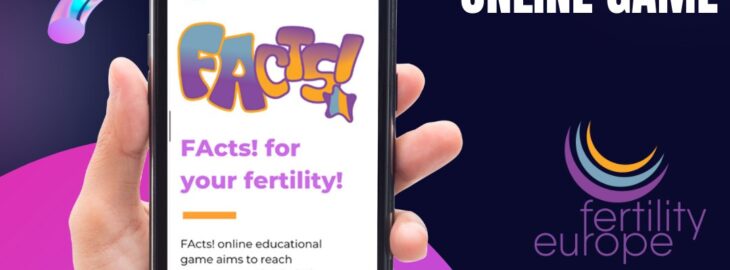
This is where the FActs! offers a solution. Originally an idea of ESHRE’s past chair, Roy Farquharson, the project was developed by Fertility Europe with support from ESHRE. FActs! is an online educational game designed for teenagers in Europe aged 15–18. Its purpose is to provide young people with essential fertility information in an engaging, interactive format, while also mapping fertility awareness levels.
Freely accessible via smartphone or computer, the game can be played in under five minutes. Players answer multiple-choice questions set in everyday teenage environments—the schoolyard, a party, the gym, and a relative’s house. Each scene introduces questions covering four key areas: fertility, infertility, lifestyle factors, and STIs. Graphic design, music, and language are tailored to appeal to a teenage audience. After playing, users can compare their scores with national and European averages and are encouraged to replay and improve.
Since its launch during ESHRE’s annual meeting in Copenhagen in July 2023, the FActs! game has been played over 11,500 times. About two-thirds of the players are teenagers; the rest are adults—mostly teachers and fertility advocates engaged in dissemination efforts.
The project began in four pilot countries—Bulgaria, Norway, Poland, and Portugal. These were chosen for their geographic, cultural, and economic diversity, as well as the presence of active national infertility patient associations: Zachatie (Bulgaria), Ønskebarn (Norway), Our Stork Association (Poland), and APFertility (Portugal). Promotion activities included direct outreach to teachers and school leaders, classroom demonstrations, the creation of student and teacher ambassadors, and incentive programmes for schools integrating the game into lessons. Awareness was further expanded through press conferences, media coverage, and strong social media presence.
Interest soon extended beyond the pilot countries. Today, the game has been played in nearly every European nation.
Preliminary results reveal a patchy picture of awareness. Across countries, teenagers achieved an average score of around 70% correct answers, indicating a moderate level of knowledge. Regardless of cultural or economic background, European teenagers demonstrated remarkably similar understanding of fertility-related topics. Awareness was highest in lifestyle-related questions (87% correct), but notably lower in areas related to fertility itself (such as is obesity a risk for fertility) (55%) and STIs (63%). Infertility questions (for example, when to seek help) had slightly better results (76%). Overall, these figures suggest that while young people grasp general health concepts well, essential knowledge about reproductive biology and fertility remains incomplete.
The message is clear: Europe needs broader, structured fertility education. Yet embedding it in national curricula would require years of development, coordination, and funding, as well as adaptation to local educational frameworks.
Meanwhile, FActs! offers a rapid, scalable, and cost-effective complement to this process. Its online format allows immediate access to all interested users, while its playful interface makes learning both intuitive and appealing.
Importantly, one of the game’s most striking findings is the uniformity of knowledge levels across countries. This is evidence that, despite Europe’s diversity, a shared digital platform can achieve comparable educational outcomes. In this sense, FActs! not only supports learning but also strengthens a shared European understanding of reproductive health.
The collaboration between Fertility Europe and ESHRE has been central to the project’s success. Fertility Europe’s member organisations are passionate advocates of fertility awareness and bring diverse professional and cultural perspectives. Their creativity and outreach skills have given the game a distinctive appeal—visually engaging, easy to use and technically flawless.
Looking ahead, further analysis of the collected data is underway and will be presented in upcoming scientific publications. The project’s early success illustrates how collaboration, innovation, and advocacy can combine to create meaningful educational impact. Fertility education is not merely about reproduction—it is about empowering the next generation to understand their health and opportunities so they can make informed decisions later in life.
The FActs! game is a step in that direction.
You can play the game and test your own fertility awareness at myfacts.eu. A report is also available at Fertility Europe’s website. Feedback is warmly welcomed at office@fertilityeurope.eu.

You have to be logged in and an ESHRE member in order to comment.