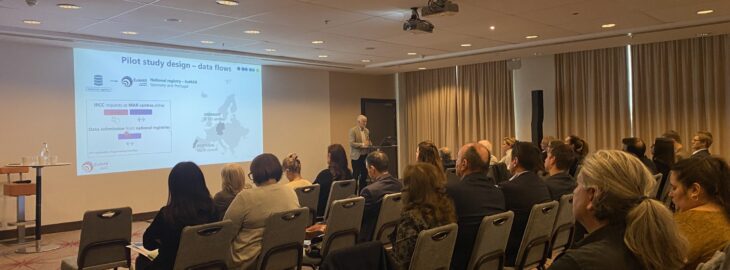
This hybrid conference brought together more than 70 in-person attendees and over 100 online, including infertility professionals, patient representatives, national health authorities and policymakers, as well as industry stakeholders. Throughout the day, speakers highlighted how EuMAR has laid the foundations for a new chapter in MAR data collection in Europe.
The EuMAR project, co-funded by the European Commission, was launched in 2023 with the ambitious goal of establishing the first cycle-by-cycle registry of medically assisted reproduction (MAR) data across the European Union. Building on more than 20 years of experience in collecting aggregated MAR data, ESHRE experts saw the need to modernise data collection in our continent to reflect the rapid advances in infertility treatment. Patients with infertility increasingly undergo multiple treatment cycles, often across different clinics and sometimes in different countries. In this evolving landscape, aggregated data alone can no longer fully capture treatment pathways or accurate outcomes. High-quality, cycle-by-cycle data are essential to improve care and safety for patients, inform public policy and advance research in the field.
Session 1: Origins & goals
After the opening remarks by Prof Carlos Calhaz-Jorge, the Chair of EuMAR, the introductory session focused on the thinking behind EuMAR, its policy context and early stakeholder engagement. Prof Christian De Geyter (Switzerland) introduced the session by highlighting the value of registries as tools for surveillance and vigilance. He reviewed ESHRE’s historic role in MAR data collection and outlined the policy context under which EuMAR was founded, including the SoHO (Substances of Human Origin) Regulation, the European Health Data Space (EHDS) and the General Data Protection Regulation (GDPR).
Dr Cristina Magli (Italy) followed with a focus on the results of stakeholder engagement activities and the views of professionals and patients on the EuMAR registry. Survey results showed strong patient support, with more than 88% of patients willing to share their data and more than 76% reporting greater trust in fertility clinics participating in EuMAR. Dr Magli also announced that Poland and Greece had started formal engagement for their participation in EuMAR, with additional countries expected to follow.
The final presentation of the session was delivered by Elena Achótegui Sebastián (Spain), EuMAR’s project manager. She introduced the guiding principles and overall structure of the registry, including data inputs and outputs designed to benefit different stakeholders. Among these output data are the patient reports, dashboards, EIM reports and access to EuMAR data for researchers. A particular emphasis was placed on the solution to collect cumulative and cross-border data while ensuring data protection: EuMAR enables the linking of treatment cycles from the same patient or couple, including in cases of cross-border reproductive care, through an encryption mechanism of different patient codes, namely the Individual Reproductive Care Code (IRCC), the ClinicSwitch code (CSC) and the EuMAR code.
Session 2: Implementation & lessons learned
Prof De Geyter returned to the stage to share the insights from the EuMAR pilot study and its technical validation, challenges, and solutions adopted. The pilot study collected data on treatments carried out in Portugal, Slovenia, Germany and Estonia between July 2024 and September 2025.
During the pilot study period, EuMAR recorded a total of 21,202 treatment cycles from over 28,000 individuals, including main patients, partners, and oocyte donors, from participating countries. Of these, 4,310 main patients had two or more cycles and EuMAR recorded a total of4,437 pregnancies and 2,359 live born children. This represented a high level of coverage of the total number of cycles performed nationally: 67.24% in Estonia and 78.2% in Slovenia, where data were submitted directly by clinics using informed patient consent, and 91.7% in Portugal and 99.8% in Germany, where data were provided through national registries without the use of informed consent.
The presentation was followed by an extensive discussion involving both onsite and online participants, who raised questions about the presentations, but also shared perspectives on their own national contexts and how EuMAR could support their efforts.
Session 3: Outcomes
The third session addressed two key elements of EuMAR: the updated parameters and the development of dashboards and key performance indicators. Dr Jesper Smeenk (The Netherlands) explained how the EuMAR parameter list was developed, drawing on existing parameters from EDQM, ICMART, and national registries to ensure alignment and data harmonisation. He also presented the updated parameter list, which includes the removal of certain parameters, such as smoking status and male BMI, and refinements to definitions and concepts.
Dr Christine Wyns (Belgium) concluded the session by focusing on EuMAR’s benefits and the development of dashboards for quality assurance and benchmarking for clinics. Dr Wyns presented the data visualisations that will allow stakeholders to access outcome data at different levels. Clinics will be able to assess specific aspects of care by accessing their own cycle-by-cycle data and benchmark themselves against national and European values. National competent authorities will benefit from increased transparency for decision-making, while researchers, patients and the public will have access to dashboards with aggregated data to support specific research questions and raise awareness. Although the dashboards were not tested during the pilot phase, they are now being finalised and represent a promising tool for participating countries.
Session 4: Looking ahead
The final session focused on the future of the registry, where Dr Smeenk presented EuMAR 2, a proposed two-year extension of the project running from 2026 to 2028. Fully funded by ESHRE, EuMAR 2 aims to bridge the gap between the pilot phase and a fully operational, permanent ESHRE activity. This next phase will strengthen existing features; further test cross-border data collection, dashboards, KPIs and benchmarking; facilitate researcher data access; explore long-term financial sustainability through external funding opportunities and connect at least ten countries. Participation will be open to all European countries, not only EU Member States.
The last presentation, by Rita Piteira from the European Commission (DG SANTE), outlined how EuMAR could support EU Member States with SoHO reporting, including reporting on new SoHO preparations and its outcomes, and activity data from SoHO entities. DG SANTE expressed strong support for EuMAR and encouraged countries to use the EuMAR registry to report to the SoHO platform as contemplated in the regulation, which allows reporting through an international registry.
The subsequent discussion highlighted the audience’s broad interest in a European cycle-by-cycle registry of MAR as a tool for early risk detection, which was followed by questions regarding donor registries, currently outside of EuMAR’s scope, largely due to GDPR constraints.
Closing remarks and policy recommendations
The conference concluded with final remarks from Prof Carlos Calhaz-Jorge, who emphasised that EuMAR’s success will depend on the active participation of national authorities, MAR professionals and patients. He underlined the registry’s potential to empower patients and make a crucial contribution to improving clinical care. He closed by presenting the EuMAR policy recommendations:
- Improve equitable access to fertility care
- Collect MAR Equality data
- Ensure national mandatory reporting from all clinics
- Provide dedicated funding for EuMAR reporting
- Develop a legal framework for a gamete donor registry
- Make cycle-by-cycle MAR registries mandatory
- Raise patients’ awareness on MAR data

You have to be logged in and an ESHRE member in order to comment.